
A refrigerator is a salient utility of every household. It maintains the quality and taste of the food we consume every day. It also provides the recommended environment (cold temperatures) for medicines. However, ever wondered how does a standard refrigerator work? The process is simple, fascinating and easy to understand.
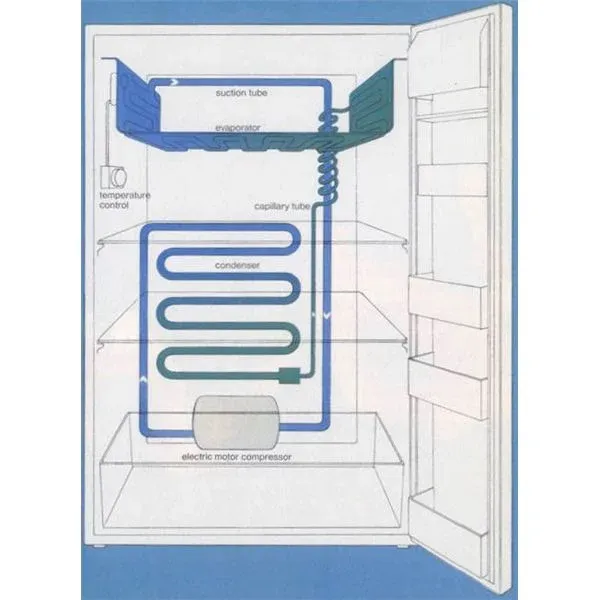
There are four main components in a refrigerator: Evaporator Compressor Condenser Expansion valve/Capillary tube
The working fluid is known as refrigerant which exists in both liquid and gas state depending on the cycle stage of the refrigeration process.
Cycle Stage-1: The cold refrigerant (in liquid state) enters the evaporator (Evaporator is inside of the refrigerator) where it absorbs the heat from hot/warm food and converts into a gas state at elevated temperature. (Think of steam generation when boiling water in a kettle. Water absorbs the heat from the electric element inside the kettle).
Cycle Stage – 2: The gas refrigerant flows towards the compressor where it gets compressed thus raising the temperature and pressure of the refrigerant. A compressor is the heart of the refrigeration cycle. It uses electricity to operate and therefore an efficient and effective operation of the compressor is essential.
PrCycle Stage – 3: Following compression by the compressor, the hot gas refrigerant passes through the condenser (Condenser is situated at the back of the refrigerator) where hot gases radiate heat to the atmosphere (in the Kitchen or where the refrigerator is situated). During halfway through the condenser, the hot gases turn into the relatively cold refrigerant and begin to go through a state change i.e. from gas to liquid.
Cycle Stage – 4: The liquid refrigerant flows through the expansion valve to ensure that the entire refrigerant is cold due to a sudden expansion. The cold liquid refrigerant then flows through the evaporator and the cycle starts again.
The efficiency of a refrigerator is measured as the coefficient of performance, unlike boilers which have a measure of thermal efficiency.
COP = Heat (energy) absorbed from the contents/food (evaporator)/electricity to run the compressor
The electricity consumed by a compressor is dependent on the cooling load of the refrigerator which is dependent on:
The temperature set-point of inside the refrigerator The temperature of the food stored such as pre-chilled milk will cost less than the same quantity of hot milk The amount of food stored The frequency of opening the fridge door and letting in warm air (infiltration)
A refrigerator with a COP of 2 and cooling load of 10kW will require 5kW of electricity, as below.
COP (cooling) = Cooling Load÷Electricity
Electricity = 10kW÷2
Electricity = 5kW
Energy rejected by the refrigerator is slightly higher than the energy absorbed from the food inside the refrigerator because the electricity consumed by the compressor converts into heat energy. The compressor also needs to be kept at acceptable temperatures to function. The energy balance is shown below:
Heat Rejected (Condenser) = Heat Absorbed (Evaporator) + Electricity consumed by the compressor
The above energy balance shows that heat output from the condenser is always higher than cooling inside the refrigerator. Therefore COP of heating is always equal to COP of cooling plus one.
Heat output = Cooling load + Electricity
Heat Output = 10kW+5kW
Heat Output = 15kW
COP (heating) = Heat Output÷Electricity
COP (heating) = 15kW÷5kW
COP (heating) = 3
It is important that heat is rejected away from the condenser for the efficient and effective operation of the refrigerator. Therefore the refrigerator should be placed in a well-ventilated area so that the heat rejected by the condenser moves away from the area where the refrigerator is placed. The cooler the space the better the heat transfer between the condenser and the air in the space. Assuming the condenser rejects heat at 30°C, the temperature of the space needs to be maintained below 30°C otherwise no heat transfer will occur and the compressor will stop working.
A refrigerator condenser can be fitted with a fan that draws in the air over the condenser coils. This air then becomes warm and rises above the refrigerator due to a decrease in its density. This is a common practice in hot countries where a refrigerator placed in a corner struggles to reject heat due to local hot air temperature. The additional condenser fan helps to move hot air and draws in relatively fresh air to help the condenser reject its heat. The fan is mostly fitted at the rear bottom of the refrigerator so that it can draw a relatively cold air. The additional electrical energy by the fan is mostly outweighed by the increase in efficiency of the refrigerator due to better heat rejection by the condenser.
All the fridges have first problems because the water vapour in the air converts into liquid and then freezes on the surface of evaporator tubes which is an additional cooling load on the fridge. The frost/ice between the food and the evaporator acts as a thermal barrier and reduces the effectiveness of heat transfer and therefore causes energy waste. Modern refrigerators are equipped with an auto-defrost function which use electric heaters to melt down the ice. The ice converts into liquid and runs down through the drain tube. The drained water is collected in a special container at the bottom of the fridge and evaporated into the air using heat from the compressor and carried over by air. Defrosting is an expensive operation as it uses electricity. As discussed above, avoiding frequent infiltration will reduce the cooling load and maintain heat transfer efficiency of the evaporator inside the fridge.
Fridge freezers have to satisfy an energy rating of minimum A+ since 2012, however, the energy label shows a high rating of A+++ which will be much cheaper to run as compared to A+.
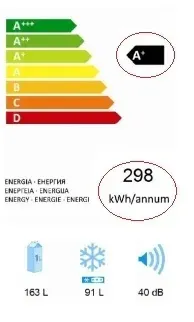
It might be a good time to replace a refrigerator over 10 years old with a highly efficient refrigerator which may pay back within a few years via a reduction in electricity bill. The energy label also shows an approximate annual energy consumption which can be used to calculate the annual running cost of the refrigerator using the unit rate of electricity, as below. Annual running cost = Annual electricity 298 (kWh/annum) x Electricity rate (£0.14/kWh) Annual running cost = £41.72/annum
The efficiency of the refrigerator increases with increase in inside temperature set-point (such as storing food at 9°C than 8°C). Similarly, the efficiency of the refrigerator increases with decrease in the condenser temperature such as rejecting heat at 20°C rather than 30°C. The table below indicates the energy and costs savings opportunities for any refrigeration or cooling machine.
| # | Energy Saving Actions | Type of opportunity |
|---|---|---|
| 1 | Setting fridge temperature at the recommended level and reviewing seasonally | Reduction of cooling load |
| 2 | Cooling hot food at room temperature before storing in the fridge | Reduction of cooling load |
| 3 | Placing the refrigerator in a well-ventilated area | Energy efficiency |
| 4 | Defrosting the evaporator | Energy efficiency |
| 5 | Cleaning of the condenser | Energy efficiency |
| 6 | Avoiding frequent use (opening the fridge door) | Reduction of cooling load |
| 7 | Maintaining the water drain tube clean | Energy efficiency / Reduction of cooling load |
| 8 | Maintaining the door seals | Avoiding additional cooling load |
Though a refrigerator is a source of cooling, it gives up heat as by-product. This free heat can be used for space heating or hot water generation for large scale cooling systems. Therefore, a refrigerator can also be a source of heating if we replace the condenser with the evaporator i.e. heating cold food inside the refrigerator and rejecting cooling energy in the kitchen. Such type of device is called heat pump which is used for generating hot water and has same operation cycle as household refrigerator. What energy efficiency actions you may take to improve the energy performance of your refrigerator?
